
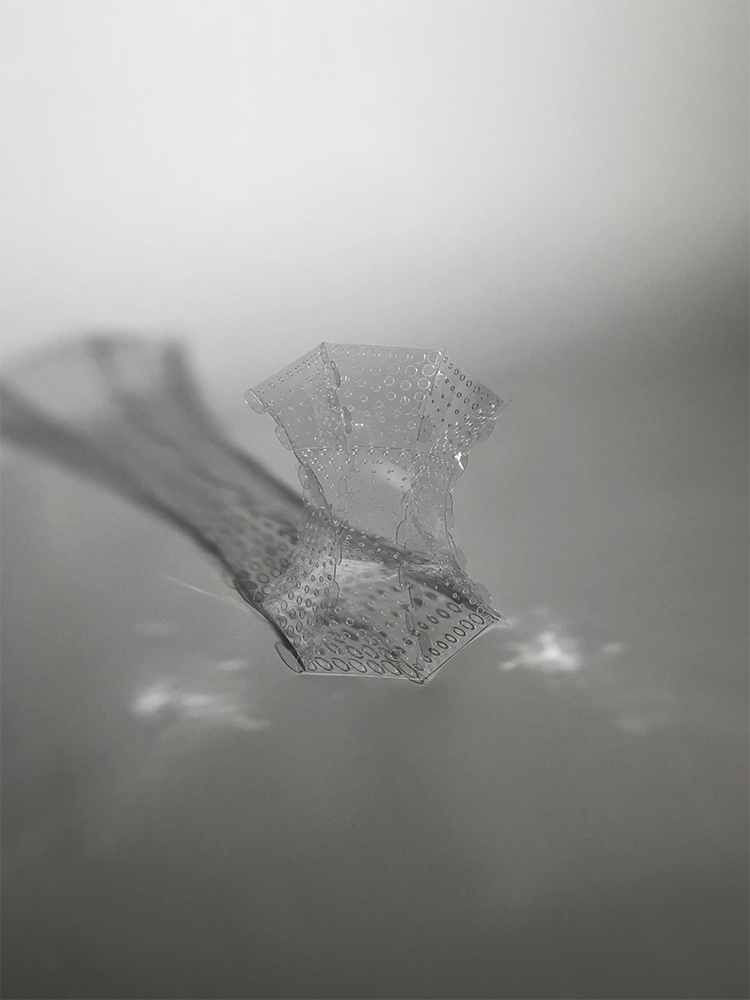
In Medium Design, Keller Easterling argued for tacit knowledge, and affordance, which constantly interact with a hand.
In Medium Design, Keller Easterling argued for tacit knowledge, and affordance, which constantly interact with a hand. The disposition that Easterling referred to can also be applied to the potential of fabrication machines and how they limit and expand the possibilities of the result, instead of the result itself. Through the manufacturing process of this responsive surface, I referenced a grasshopper code image circle to map circles to an irregular geometry that can be folded into a vase. This allowed geometries to fill an irregular edge with circles and gaps. The trimmed cylindrical surface reacts to the pattern that the user intended to generate but also by extracting points of the surface edge to adjust the pattern’s gradient. The grasshopper script allows for a flexible reconfiguration of patterns that can be categorized by numbers instead of curves. This shift prompts the simultaneous adjustment of the fabrication result in digital space thus allowing me to visualize simultaneously rather than drawing curves in Rhino 3D to map the distance to scale. However, the fabrication process remains indifferent to humans since the ZUND machine can not make revisions while in production mode. The linear logic of the production prevents more interactive workflow as Esterline points out, and becomes an inhibitor of tacit knowledge.