
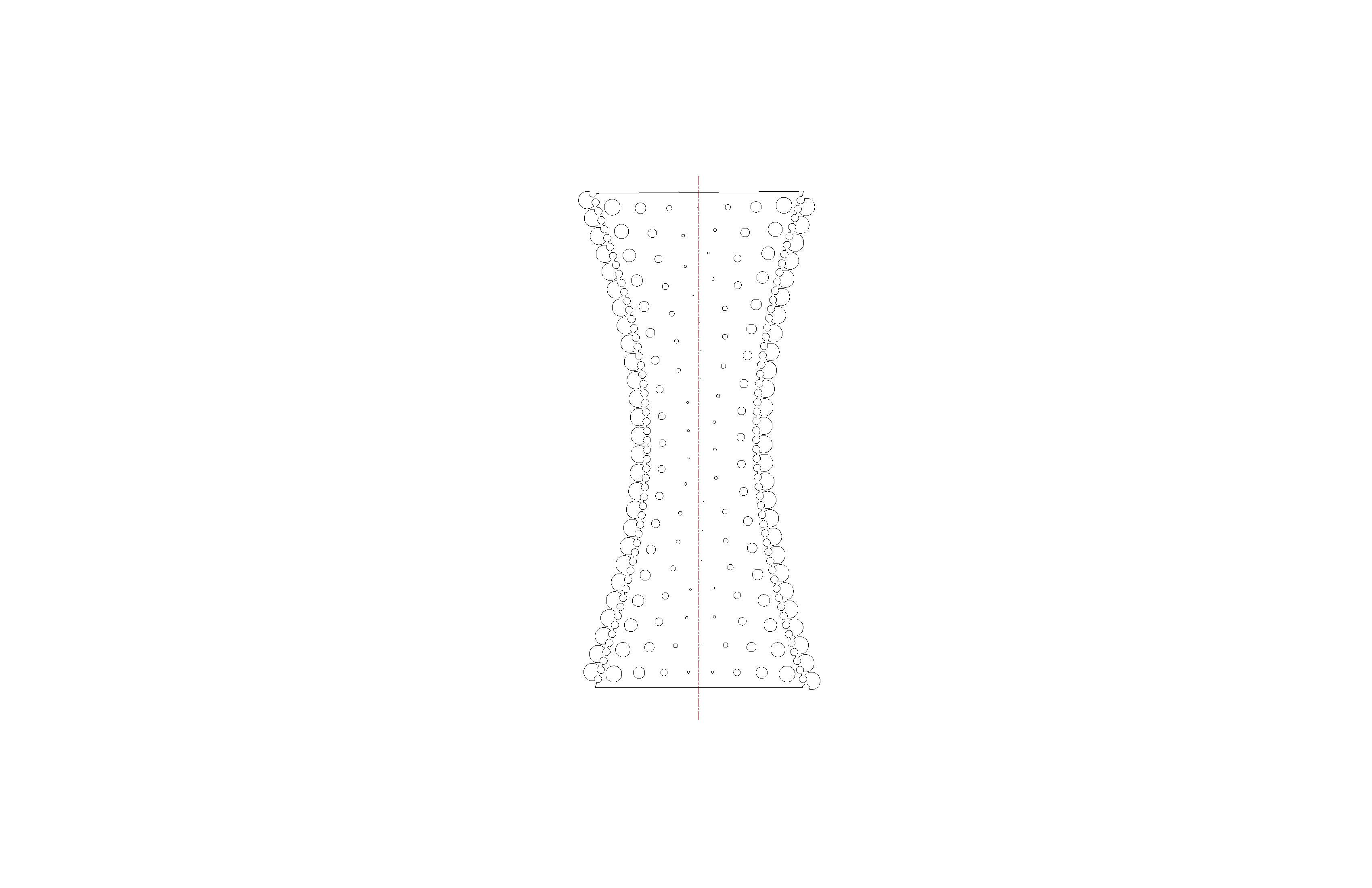
Deployment of randomized circles on developable surfaces
The common UV subdivision methods in Grasshopper and Rhino rely on fixed parameterization, which often leads to awkward residue or leftover space when applied to surfaces with irregular boundaries. In contrast, a method based on randomly distributing points across a surface avoids this rigidity, allowing for a more adaptable subdivision strategy. By controlling only the radius of circles placed on the surface, this technique can be optimized to minimize gaps, ideally achieving a near-complete coverage. Furthermore, this process can be extended by integrating connective seams between the circular elements, enabling a continuous textural logic across a developable surface.