
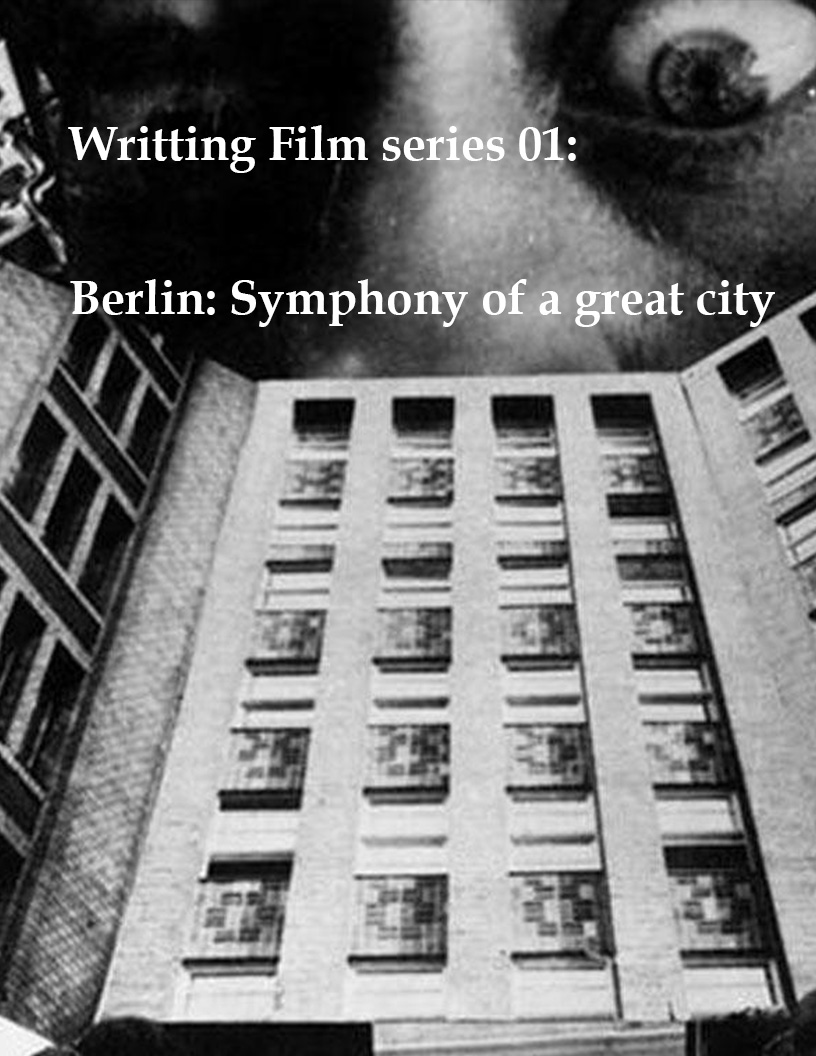
How does smoke changes the understanding of urban space in film: Berlin: Symphony of a great city
The movie Berlin: symphony of a great city introduces us to a unique set of scenes that depicts a day in the city of Berlin. The movie captures the everyday experience of Berlin yet strangely captures the mundane parts of Berlin with uncanniness. This paper looks at the role of air as a medium, specifically how it sets up or eliminates cultural division through transparency.
The Train as Atmospheric Machine
From 1:30 to 2:11, the moving camera describes the movement of telephone wires passing by. (1) With it, a sequence of rapid crosscuts of the railroad and train connectors. In this film entry, no character has been introduced. It inevitably foregrounded the train as a machine moving along the countryside, lacking ethnographic content. We do not know whether it’s carrying visitors, who are the visitors, or if it’s carrying cargo. As the camera moves along the railroad, the countryside looms with the blurriness of the fog in the background and the foregrounded steam released from the locomotive engine. While the background of the scene remains foggy due to the moisture in the air, the smog in the foreground is framed such that the source of the smog is unidentifiable in the sequence. It automatically connects the cloud and the steam in the foreground and background. It is as if the railway is elevated from the ground and flying through the countryside. This analogy is confirmed through the rapid crosscuts in which videos of moving telephone wires, the railroad, and the wheels are overlaid. Among these cuts, two points of view shot at different angles pointing toward the cloud are intentionally mingled with the steam released from the steam chest, which occupies the top portion of the screen. Thus, the analogy established through these cuts compositionally softened the difference between cloud and steam since they are both composed of small water droplets and have similar opacity.
From 3:34-3:39, as the train stops (2), it is the first time that the viewer is given a holistic view of the lower portion of the steam locomotive, which is composed of mechanical parts that control the direction and power of the locomotive. The steam switches from a symbolic sign between cloud and steam to the indexical sign that symbolizes the machine. These cuts zoom in from a different perspective to show the steam chest. The smoke in the second montage occupied half of the screen for about one second and a half, concealing most of the mechanical parts and revealing in the last scene the condensation of vapor on a smaller machine that proves the steam is, in fact, vapor, and not smoke. The opening sequence of the film ignores the ethnographic content of the train. Instead, it describes an experiential feeling rather than logical fact as a transcendental experience. As the steam gradually shifts its position from the top, middle, to the bottom portion of the screen, it describes the movement of ascension—the feeling of ascension through clouds. Since the concept of crossing boundaries has a symbolic meaning of obeying the roles of another realm, the entering sequence creates an anesthesia effect for the experience of crossing boundaries between suburbs and city, making the experience of crossing boundaries analogous to a heavenly transcendence. The analogy between cloud and steam thus blends the cultural and natural forces into one coherent picture that created a soft transition between nature and culture.
From 4:16 - 5:01, When the camera arrives in Berlin, a clock tower is shown, and an abstract sky is backdropped. The clarity of the sky suggests the stagnant air and thus establishes a semiotic meaning that the city is a dormant creature sleeping and waiting to be awakened. (3)The emptiness of the street sets up the backdrop of the aesthetics of lost objects, followed by the next scene, in which a trash bag is floating purposelessly in the air. (4) From 6:20- 6:27, This wandering object relates to a lost toy of Elsie that also appeared in the technique used in M. What makes this ordinary scene feel like a beautiful uncanny event is that the most privileged location of the camera lens focuses on this moving object whose trajectory moves from the sidewalk to the curb ramp then toward the sewer. Curb ramps are usually designed to make it easier for a person to transition between the street and the pedestrian road. Therefore, the wind animated the trash bag by resembling the movement of a stray animal. The animation of an unwanted commercialized product can be confirmed by relating this scene with the following scenes where a man walking his dog along the sidewalk and a man dragging the poles balloons and letting them slide on the ground in his hand had an analogous composition. (5)[6:38-7:10] The analogy has again made the city and nature symbiotic. The ordinary experience of urban unhygienic conditions is thus framed as an unexpected encounter with a stray animal on the urban street. The cultural analogy of city and nature formed a double relationship through the analogy of air. This analogy not only adds dynamism to the still background of the empty street front, since it’s the only moving object on the screen, it also becomes the figure of the stage set instead of a visual noise. This sets up an ordinary moment composed of existence between nature and the city and creates tension between the coexistence of these two contrasting elements.
[7:49 - 8:27] The train in the city is strangely depicted as the activator for a day in Berlin. This scene is peculiar because opening the doors here is highly synchronous, as if everything has been choreographed as the opening of an opera, embedding a certain degree of theatricality into the opening of a train station. (6)Similar to the 7 deadly sins scenes in the metropolis, Compositionally, there is a circular array and a moving element in the middle. The train slowly moves towards the camera, forcing the viewer to have a frontal confrontation with the train as it approaches. This is uncomfortable because a set of still objects is given humanoid characters and becomes animated. The head of the locomotive resembles the face of a human with parallel lights. The steam occupied a huge portion of the train and, for a brief moment, temporarily eliminated the sight of the ground. Compositionally, this scene is similar to how Fritz Lang depicted the 7 deadly sins. As we’ve seen from multiple different cultural artworks, deities depicted by artists use clouds as a transportation method and deny the basic law of gravity. With the face of a human, the moving method of a godly figure, and the composition of transforming from still objects to life, this scene establishes an analogy between the locomotive and the deity. Air becomes the agent that makes this analogy possible when it reads as a medium. This also aligns with the concept of ascension in the entry scene. How cultural objects are juxtaposed with characters of nature or even supernatural characters through air. Thus, the steam becomes the medium that establishes a connection between forces of culture and forces of the supernatural. The monotony of an everyday experience is thus transformed into a visual spectacle.
Erasing Monumentality Through Smog
From 14:38 - 14:55, after a tour of the glass manufacturing factory, we first see a shot of the smoke as a figuration in the middle of the background space. Therefore, the other chimneys on the screens are pushed to the less privileged positions. The feeling of ascension is again made legible here as the crane lifts the weight and the rising steam. (7) This again confirms the role of steam as a cloud that signifies the movement of ascension in the beginning entry scene. One can also read this ascendance as vertical movement of class, as a symbol of class mobility, as if workers can ascend to higher positions through working hard in a city, filled with numerous opportunities.
The role of translucent air shifts when more visual context is shown around the city. Air is no longer the agent that establishes a connection between two unrelated milieus; now, the opacity of air aims to erase the limits of representation. Between 21:55 to 22:00 (8), the train moves through the street market of Berlin, filled with smog. The smog is so thick that we can barely see the chapel in the background. Without the chapel that serves as the “needle” of the city, the feeling of monumentality is diminished. Thus, an intimate scale of the street is established, along with the horses in the scene representing the rural life of a village. The steam that the locomotive releases gradually forms an opaque materiality that erases spatial depth. Therefore, the existence of horses feels less abrupt in the same space as cars and locomotives through the erasure of the chapel. Here again, the tolerance of the city to a diverse mode of transportation is clearly shown through smog and steam that softens the urban and rural contrast. Since modes of transportation have been symbolized as class signifiers,the movie’s preference to create a suburban image of the city, while maintaining urban transportation methods alludes to tolerance of the working class men and different groups of income.
Steam and the Dissolution of Social Boundaries
Between 26:33 to 26:38, A strange set of scenes are juxtaposed to contrast the interiority of the shop. The coffee shop is shot at a position right in front of the glass window pane in which a well-dressed server is making coffee. His hair is neatly cared for, and the reflection(opacity) of the hair and the machine further highlights the transparency of the glass pane in the background. The backdrop thus turns to the urban street of Berlin. This is particularly interesting because the window pane creates a physical boundary separating the air between the public and private entities. However, the interior steam emitted from the boiler blurs the window frame as if the boundary of interior and exterior air disappeared and resituated the coffee shop to the urban street. Thus, the steam, with its legitimacy to exist in the physical space of the film, becomes the agent that eradicates the fixity of social class separation. The limit of representation thus is released to accept more possibilities of interpretation.Through this scene, the city softens the boundary between working class and upper-class men. (9)
Steam as Aesthetic Neutralization of Capitalist Signage
From 30:27-30:46, a train moves through the city, and with its smoke, it arrives, bringing airflow into a stagnant city and thus supplementing nature’s role in generating wind into the city. The scene is odd because the opacity of the steam blurred the billboard in the background and the windows right next to the railroad. It is odd that the text of the billboard is blurred, but the woman on the billboard is not. The opacity of the smoke thus eliminated the specificity of the content that the billboard aims to convey and left the image to speak for its generality, which leads the audience’s attention to an image of sexually attractive women in a cloud. The steam’s immateriality and dynamic boundary don’t register as a solid object to our perception. Thus, the eye of the audience registers the immaterial object as a natural phenomenon instead of an opaque wall. The entropic formation of steam, smoke, wind, and condensation symbolizes unintentionality. Therefore, steam decapitalizes the billboard and turns it into an aesthetic image. In the following scene where a close up view of the window next to the railroad is shot, if the steam is removed, the spectator will understand the window is a literal figuration of high urban density and lack of connection to nature. However, this juxtaposition of steam and window is so beautiful because there is some fantasy about looking at a cloud through the window. It means that the steam, which symbolizes clouds, creates an illusion that covers the issues caused by high urban densification, as if there are no adjacent structures that block the view to nature. Therefore the steam eliminated urban visual noise and thus alleviated the perception of the urban density of Berlin. (10)
Clear Air and the Reinforcement of Class Separation
Between 32:10 and 32:29, the scene where an exquisite hotel is shown(11), the revolving door occupies the center of the lobby space. Thus, it signifies an always-closed door, separating the interior and exterior air. This separation suggests a difference from the previous scene of the coffee shop. A sign of class difference is delineated by capturing the servant and the guest. We see here that the transparency of air signifies stagnancy and thus makes the absence of air circulation visible, plus the revolving door is always closed. The stagnancy of air in an interior space thus strengthens the concept of boundary. This is the second time we see class differences delineated through the degree of clarity of air. The clarity of air in this scene serves as the agent that signifies the boundary , thus separating the hotel from the urban street, and it serves as the condition that brings high resolution to the foreground. Through this high resolution, the spectator can comprehend the entirety of the screen without any “unexpected disruptions.” Without the role of the different opacity of steam and smog, the venue looks flat and doesn’t seem to have a rich spatial depth as before. This flatness thus points to no one as the center of visual focus, Almost as if the event happening in the niche of the upper class is equally important.
Interior Air as a Privileged Urban Commodity
From 34:50 to 34:58 (12), the crossing of the street again makes the interior air concept an upper-class signifier. Those who can afford a taxi have the right to control its bubble climate. This difference is even represented by pedestrians crossing the road awkwardly; formally dressed people have to look for gaps to cross the road. Uniforms no longer serve as the signifier of class status in urban space, instead the difference between interior and exterior air renders who is privileged and who is on the margin. This puts pedestrians at a lower class in the urban space than those who travel in machines. The privileged interior air is further confirmed in the last part of the movie starting from 52:29 to the end, where all the entertainment facilities take place indoors and the clarity of air contrasts with the first half of the movie, showing the back side of Berlin. In conclusion, the role of air in the film’s first half alleviates urban issues in terms of speed, density, and pollution. Yet the latter half strengthens the concept of separation of entertainment events from the urban streets, excluding working class men from these venues. Air becomes the critical agent that brings the force of nature and culture together when the city is at work. When the city is at rest during the night, the clarity of air eliminates the possibility to establish an analogy with nature and thus is less tolerant toward working classmen, instead, focused on capitalism and clear social division. The theme of tolerance and exclusion is thus established through the opacity of air. Higher opacity is analogous to clouds, heavenly experience, supernatural phenomena, and erasure of urban fixity. Lower opacity symbolizes legible class separation. Thus, the opacity and clarity of air constructed a version of Berlin with a contrasting twin personality when at work and at rest, whose attitude shifts from high tolerance to low tolerance toward the working-class men. Thus air becomes the critical medium that reveals the duality of the city of Berlin in Ruttman’s Berlin: symphony of a great city .